
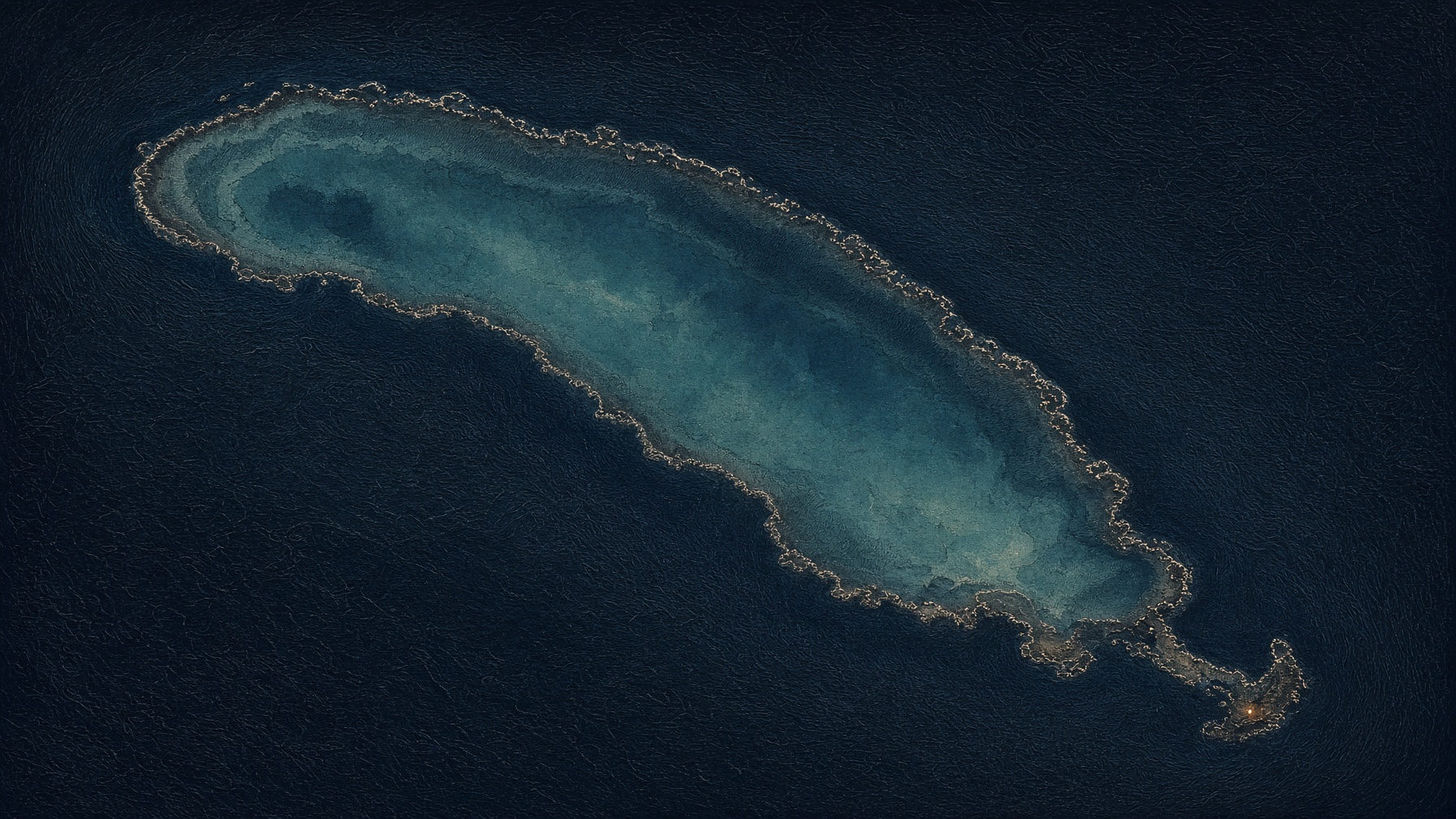
Pacific
Kwajalein Atoll
Omelek
9°03′ N · 167°45′ EMarshall Islands
Encounter 02 · 02 of 42 · 28 September 2008 · 18 March 2012
Important enough
A 2012 sentence about odds. A 2008 rocket. They are not the same night.
Omelek Island, Kwajalein Atoll
Listen · Eve
The pad is small. Notice how much ocean is around the decision. Then ask why this island, not only how it looks.
A fourth Falcon 1 stood on Omelek, a few acres of uninhabited reef on Kwajalein Atoll. The Pacific is most of the picture. Orbit was not yet a fact.
SpaceX was incorporated in 2002 to build, not to buy. Later recollection (Jim Cantrell, Ashlee Vance, Musk on 60 Minutes) says the preceding plan had been a greenhouse on Mars, and that buying a refurbished missile in Russia did not survive the price. That office, and no other: launch cost became the problem, so building replaced buying. It is not a 2002 press kit.
Why this island
- 29 June 2005First flight moved from Vandenberg to Omelek. A last Titan 4 with a National Reconnaissance Office payload had the range. The Air Force would not take a debris risk, Musk told Spaceflight Now, even a tiny one. “We just can’t afford to sit here for six months.” Contemporaneous.
- 2005–06Seven acres, uninhabited, U.S. Army lease, Reagan Test Site: tracking, range safety, nearer the equator. Humidity is not scenery. It will enter the first failure report.
- 18 August 2006NASA selects SpaceX for Commercial Orbital Transportation Services demonstrations. A funded demonstration agreement. Not the later cargo contract. Not cash on a 2008 pad.
The object is a small two-stage kerosene-and-oxygen rocket, about seventy feet. Merlin on the first stage, Kestrel on the second. Tom Mueller, first employee and vice president of propulsion, is why those engines exist. In March 2008 he said the next Falcon 1 would fly the new Merlin 1C from Kwajalein. This was not Falcon 9. First they had to prove a small one could finish the job. In 2008 a private company reaching orbit with a fully liquid-fueled rocket it had designed and built itself had not been done.
7.5km/s
Rough speed in low Earth orbit. Flight 2 reached about 5.1 km/s at about 289 km. That is space. It is not staying.
The four flights are not three failures and then courage. They are failure, finding, a change that entered the next vehicle, and a new unknown.
Flight 1, 24 March 2006: an aluminum B-nut on the fuel-pump inlet cracked from corrosion not visible in inspection. Kerosene leaked. Fire at about thirty seconds. A DARPA board found the locking wire still in place. It was not a loose nut. Stainless fittings and tighter inspection went into the next vehicle. Humidity treated as a cause.
Flight 2, 21 March 2007: first stage flew. At staging the interstage bumped the second-stage nozzle. LOX slosh. The engine shut down around T+7:30. About 289 km, about 5.1 km/s. Baffles and a control-logic change went into the next vehicle. The next vehicle also flew a new engine, Merlin 1C.
Expected
Flight 2’s staging gap, about a second and a half after cutoff, had been enough for the older ablative Merlin. Flight 3 flew the regeneratively cooled Merlin 1C. The same gap was expected to serve.
Observed
Flight 3’s new engine created Flight 3’s new failure. Residual propellant kept a little thrust after shutdown. The first stage recontacted the second. The payloads, including NASA’s, did not reach orbit. The next attempt was not a repetition. More seconds before staging, so residual thrust could die. That change entered Flight 4, eight weeks later.
Falcon 1, four flights. Record after the chain, not instead of it.
| Flight | Date | Result | What failed, or what held | What entered the next vehicle |
|---|---|---|---|---|
| 1 | 24 March 2006 | Failure, ~30 seconds | Aluminum B-nut, intergranular corrosion, kerosene fire. Locking wire still in place. | Stainless fittings. Tighter inspection. |
| 2 | 21 March 2007 | Space, not orbit | Staging bump, slosh, shutdown ~T+7:30. ~289 km. ~5.1 km/s. | Baffles. Control logic. Merlin 1C on the next vehicle. |
| 3 | 3 August 2008 | Failure at staging | New Merlin 1C. Residual thrust. Recontact. | More seconds before staging. |
| 4 | 28 September 2008 | Orbit | 7:15 p.m. EDT, 23:15 UTC: morning on the atoll. Ratsat, 364-pound aluminum mass simulator. No customer on board. | A fifth flew 14 July 2009. Another night. |
Contemporaneous: DARPA board via SpaceNews / Space.com, July 2006; Musk’s public Flight 2 and Flight 3 statements; Spaceflight Now, 28 September 2008. Cells are the record.
What they knew
- SpaceX had been founded in 2002 to build launch vehicles, not to buy them.
- The first Falcon 1 flight had been moved to Omelek in 2005 after Vandenberg would not accept the risk to a last Titan 4.
- Three failure reports existed. A fourth vehicle was on the pad. After Flight 3 the staging delay had been lengthened so residual thrust could die.
What they could not know
- On 28 September 2008, whether this vehicle would reach orbit.
- Whether the three changes were enough.
- Whether a company would remain if they were not.
- What, if anything, that would prove about the wisdom of flying.
The surviving fourth-flight record is a webcast and a same-day report. Spaceflight Now: a smooth countdown; Merlin 1C; first-stage burn about two and a half minutes; stage separation five seconds after burnout (the Flight 3 correction); Kestrel; fairing; a second-stage restart to circularize. Employees in the Hawthorne hangar cheered when Kestrel lit. Max Vozoff is named as mission manager. The pad is not invented.
2008The emotion I feel is much more relief than elation.Elon Musk, 28 September 2008, quoted by Spaceflight Now the same day. Contemporaneous. Not the 2012 sentence.
What failure would have meant, as far as the record will go. By June 2008 SpaceX said nearly five hundred people. Ratsat was a dummy; Flight 3 had already lost payloads, including NASA’s. On 4 August 2008, after that failure, company history records a further Founders Fund investment of $20 million. That is 2008 capital. It is not proof that a fifth rocket was waiting. In 2012 Musk said he had put on the order of a hundred million dollars of his own money into the work, and that a failed fourth would have left no resources for a fifth. Those figures are 2012 speech. They are not a 2008 ledger line we have in hand. We do not have a payroll, a visa list, or a rent book, and we will not invent one.
They flew.
The vehicle reached orbit with a dummy payload. A happy ending does not prove the gamble was wise. It proves the vehicle worked that time. Learning had entered the hardware. Whether continuing had been wise is not the same fact.
2008
The flight
Omelek. A fourth attempt after three reports. They flew. The quotation below had not been spoken yet. NASA’s cargo award had not been announced yet.
2012
Four years later
When something is important enough, you do it even if the odds are not in your favor.Elon Musk to Scott Pelley, 60 Minutes, originally aired 18 March 2012. Script later posted by CBS News. Later recollection.
Later words. Not evidence of what he was thinking on the pad in 2008. Pelley asked about the third failure, whether he had thought of packing it in. “Never.” Dead or completely incapacitated. That is a temperament, offered later, on television. It is not a law of engineering.
On 23 December 2008 NASA announced Commercial Resupply Services awards. SpaceX’s share was about $1.6 billion for twelve missions. That paper is almost three months after the pad. It is not “days later,” and it was not a fact on 28 September. COTS is not CRS. The 2006 demonstration agreement is a different paper again.
What had to change in the machine before the next flight was an attempt rather than a repetition?
Private. No one else will see it.
Source
- institutional01 · Spaceflight Now, 29 June 2005Contemporaneous. First Falcon 1 flight moved from Vandenberg to Omelek after range conflict with a last Titan 4. Musk quoted on the Air Force risk and on not sitting six months. Omelek named as a seven-acre island.Record
- institutional02 · Spaceflight Now, 28 September 2008Contemporaneous. Falcon 1 Flight 4: 7:15 p.m. EDT, Omelek, Ratsat, sequence, same-day Musk quotations (relief, not elation).Record
- institutional03 · DARPA board, via SpaceNews / Space.com, July 2006Contemporaneous. Flight 1: failed aluminum B-nut on the fuel-pump inlet transducer, intergranular corrosion, kerosene fire. Locking wire still in place.Record
- institutional04 · SpaceNews, 1 March 2008Contemporaneous. Merlin 1C qualification. Tom Mueller, VP of propulsion, quoted. Next Falcon 1 from Kwajalein.Record
- institutional05 · NASA / CRS announcement, 23 December 2008Contemporaneous for December, not for September. Commercial Resupply Services awards to SpaceX and Orbital. SpaceX: twelve missions, about $1.6 billion. Not the 2006 COTS demonstration selection, and not a 28 September fact.Record
- interview06 · CBS News / 60 MinutesLater recollection. “SpaceX: Entrepreneur’s race to space.” Script from the piece aired 18 March 2012, rebroadcast 3 June 2012, posted 20 June 2012.Record
Spaceflight · unfavorable odds · engineering risk