
Encounter 26 · 26 of 42 · 25 April 1954
The solar battery
In Murray Hill on 25 April 1954 three men showed that silicon could turn sunlight into a current worth measuring.
Bell Telephone Laboratories, Murray Hill, New Jersey
Look at the cells, not the later roof.
The telephone problem came first. Chapin needed current where batteries died and the air was wet. Selenium was the known photocell. He ran it. The numbers were not a plant. Fuller and Pearson were not assigned a sun engine. They were putting impurities into silicon. Pearson’s ammeter jumped. Chapin measured 2.3 percent and dropped selenium. That is the before: a failed material, a semiconductor experiment that was not yet a product, and a target near six percent, high enough, they thought, to matter to a telephone.
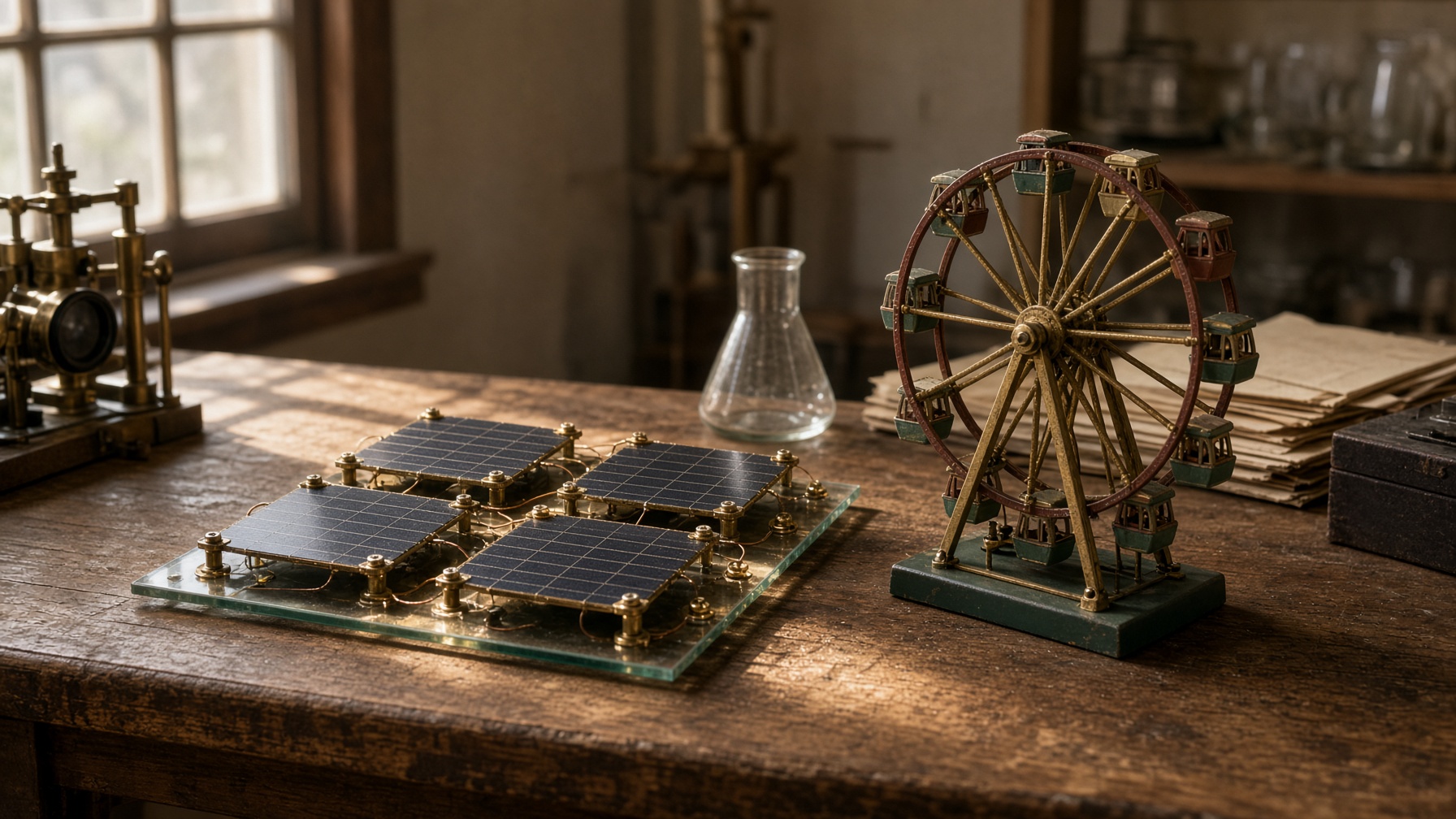
FAILURE, then a change in the machine. The first silicon was too reflective. Chapin coated it dull and the number rose. Fuller’s later recipe (arsenic in the bulk, a thin boron skin) put the junction near the surface and made contacts that held. Early in 1954 one of the coated samples reached about six percent. They wired several strips, razor-blade size, in series, and called the string a solar battery.
Expected
A selenium cell, already known, might be improved enough to feed a remote telephone.
Observed
Silicon, about six percent. Linked cells. A small Ferris wheel turned. A radio transmitted voice and music. 25 April 1954, Murray Hill.
6%of sunlight into electricity, as they measured it
A step from selenium, and from Pearson’s first 2.3 percent. Not yet a grid. Not yet a roof.
1954may mark the beginning of a new era, leading eventually to the realization of one of mankind’s most cherished dreams: the harnessing of the almost limitless energy of the sun for the uses of civilization.New York Times, 26 April 1954, front page. Contemporaneous newspaper, not a laboratory claim, and not a later industry.
1954
The bench
Chapin, Fuller, Pearson, Journal of Applied Physics 25, 676. A demonstration, a paper received in January, a front page in April. Cost still prohibitive. Niche use, radios, small things.
1958
A later orbit
Vanguard 1 carried solar cells.March 1958, afterward. Roofs and utilities are later still. The 1954 wheel is not a prophecy of a satellite. Energy as a made thing is the junction that worked that day.
A later industry is not spent backward into the toy wheel. Six percent is the chair.
They made a current from light. They did not yet make a world that ran on it.
What is energy when it is still a percent on a bench, and not yet a grid?
Private. No one else will see it.
Source
- primary01 · D. M. Chapin, C. S. Fuller, G. L. Pearson“A New Silicon p-n Junction Photocell for Converting Solar Radiation into Electrical Power,” Journal of Applied Physics 25 (May 1954): 676–677. Received 11 January 1954. Bell Telephone Laboratories, Murray Hill.Record
- primary02 · New York Times, 26 April 1954Front page. “Vast Power of the Sun Is Tapped By Battery Using Sand Ingredient.” Contemporaneous report of the 25 April demonstration.Record
- institutional03 · IEEE ETHW milestoneInstitutional chronology: selenium first; Pearson’s silicon at 2.3 percent; coating; about six percent; 25 April 1954 demonstration.Record
Murray Hill · 1954 · a made current