
Encounter 27 · 27 of 42 · 7 October 1913
The line that moved
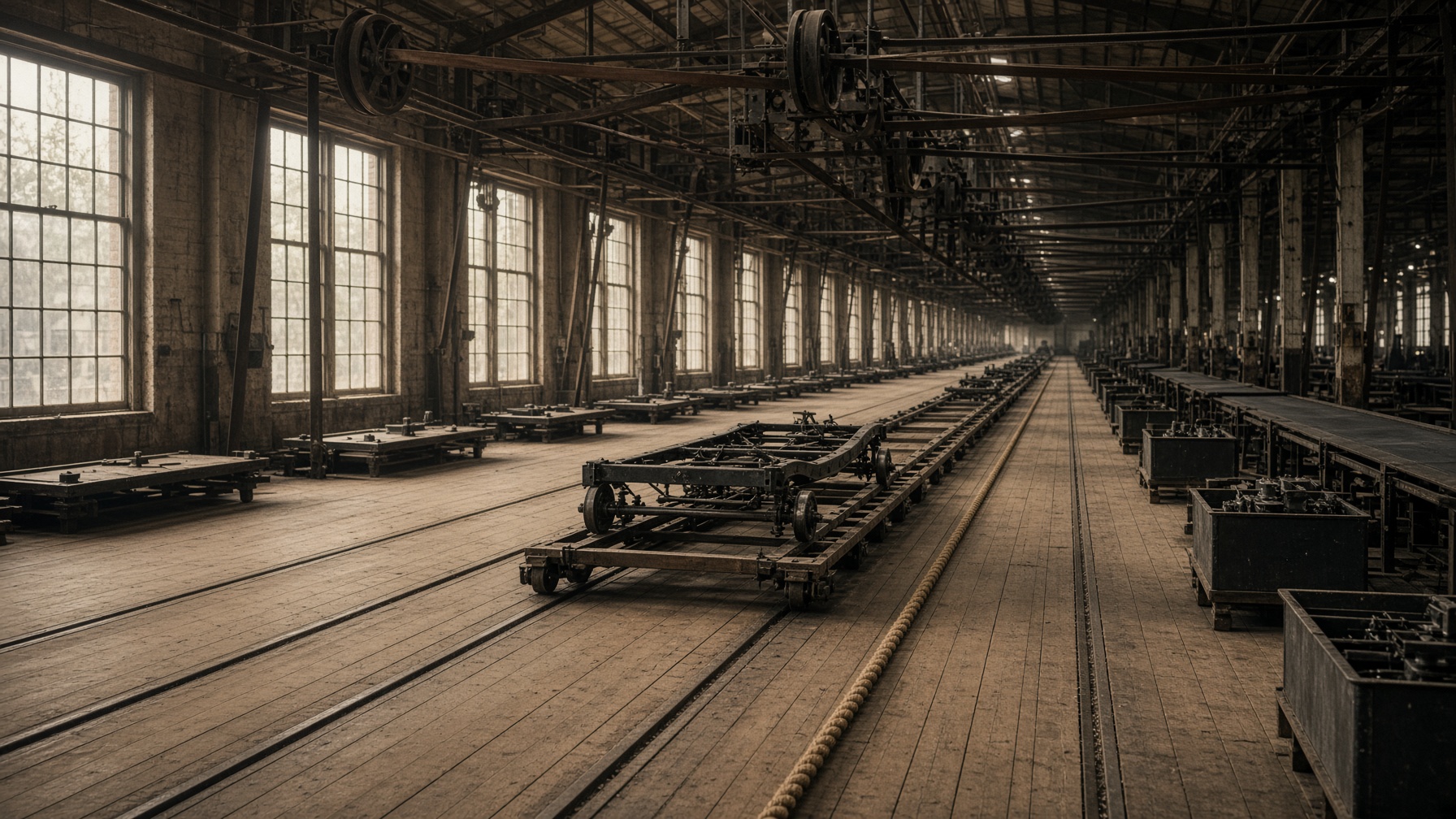
On 7 October 1913 a chassis at Highland Park was pulled past 140 assemblers by a rope. The first article was the line. The car was what the line happened to be building.
Highland Park Plant, Michigan
Look at the rope, not the later advertisement.
The plant was already a factory. Highland Park opened in 1910. Model Ts were being built by gangs who moved from car to car. That is the before, and it is not a blank. April first: a magneto. Twenty-nine steps, then fewer men, then five minutes. The work came to the person. Charlie Sorensen’s production office, and Peter Martin’s, are in the later tellings. The names on the stations mostly are not.
A moving line is not a claim that nobody had divided labor before. Ransom Olds had already used wheeled carts and fixed stations. Packing houses had already moved carcasses. The 7 October chair is this rope, this floor, this chassis, these hundred and forty people standing still while the work arrived.
What moved, and when
- April 1913Flywheel magneto on a moving line. Time from about twenty minutes toward five.
- August 1913Chassis experiments. Time falling from about twelve hours.
- 7 October 1913A hundred and fifty feet. A rope and windlass. About a hundred and forty assemblers. Twelve hours thirty minutes become five hours fifty minutes.
5h 50mthat day, from 12h 30m
Ninety-three minutes is a later conveyor, not 7 October.
What they had
- A rope
- Rails in the floor
- Stations
- The magneto lesson from April
Who was on the stations
Assemblers on the line · imposed
Pace, repetition, a day timed by the rope. They did not set the minutes.
The plant · chosen
A method that could fail in public if the cars did not come out.
Buyers later · imposed
A cheaper car. That benefit is real and not the same as standing at a station.
A cheaper automobile is not proof that the wager was identical for everyone in the room.
1913
The rope
Ford’s own heritage accounts and later engineering anniversary writing agree on the October chassis line, the rope, the length, the drop in hours. The magneto in April is the before. Hounshell sits the method in a longer history of American manufacture.
1914
The sermon
Five dollars a day. A car for the masses.The five-dollar day is 5 January 1914. Ninety-three minutes is a later powered conveyor. Fordism as a philosophy of history is afterward. The 7 October chair is a first article of a method, not a brand.
The line is the made thing. The car is what it was building that week.
The first article was the line. The ending for the people on it was not yet written.
When the minutes fall, whose day has changed, and in which direction?
Private. No one else will see it.
Source
- institutional01 · Ford corporate heritageHighland Park, 7 October 1913: chassis pulled by rope and windlass, about 150 feet, about 140 assemblers, time from 12 hours 30 minutes to 5 hours 50 minutes. Powered conveyor and 93 minutes later.Record
- scholarly02 · David A. Hounshell, From the American System to Mass Production, 1800–1932Johns Hopkins University Press, 1984. Scholarly history of the method. The line as manufacture, not as a sermon.
- interview03 · Charles E. Sorensen, My Forty Years with FordWayne State University Press reprint. Later recollection of moving the chassis past the stockroom. Not contemporaneous minutes.
Highland Park · 7 October 1913 · a first article